
First Proxmox builds have gotten ambitious. Where people once started with a single VM, the modern first-server plan bundles everything at once: Jellyfin for media, Immich for photos, a backup server, and a logging/monitoring stack — all on one box, day one. That's a fine destination and a terrible starting point if you build it in the wrong order. The trick is a planning sequence where each layer is stable before the next lands on top of it.
Plan in layers, bottom-up
The failure mode is building top-down — installing apps first, then discovering the storage and isolation underneath them were wrong. Invert it:
- Storage first. Decide disk ownership and layout before a single VM exists.
- Isolation second. VM vs LXC per workload.
- Resources third. Who gets how much CPU/RAM, so apps can't starve each other.
- Apps fourth. Now deploy onto a foundation that won't move.
- Backups + monitoring last — wrapping the whole thing.
Layer 1: storage with one owner per disk
This is where first servers most often go wrong. Decide now: does Proxmox own the disks (ZFS on Proxmox) or does a storage VM, with the controller passed through? Don't half-virtualize. Separate fast app-state storage from bulk media storage. The full reasoning is in a sane Proxmox storage plan — read it before you create the pool, because changing it later means moving everything.
Layer 2: VM vs LXC, deliberately
- LXC containers for lightweight services and anything sharing the host GPU (Jellyfin transcoding) — lighter, faster, easier device passthrough.
- VMs for things needing strong isolation or a different kernel, or a storage appliance.
Mixing is normal; choosing at random is not. Media with hardware transcoding in particular has specific needs — see media servers on Proxmox.
Layer 3: resource budgets so nothing starves
On a do-everything box, the danger is one workload eating the rest. Budget CPU/RAM per VM/CT up front: Immich's ML and Jellyfin's transcoding both spike, and a logging stack quietly grows. Cap them so a spike is contained, the same resource-limit discipline every shared host needs.
Layer 4: deploy apps onto the stable base
Only now do the apps go on — and with the foundation set, deploying from templates keeps each one consistent instead of a pile of hand-wired Compose files.
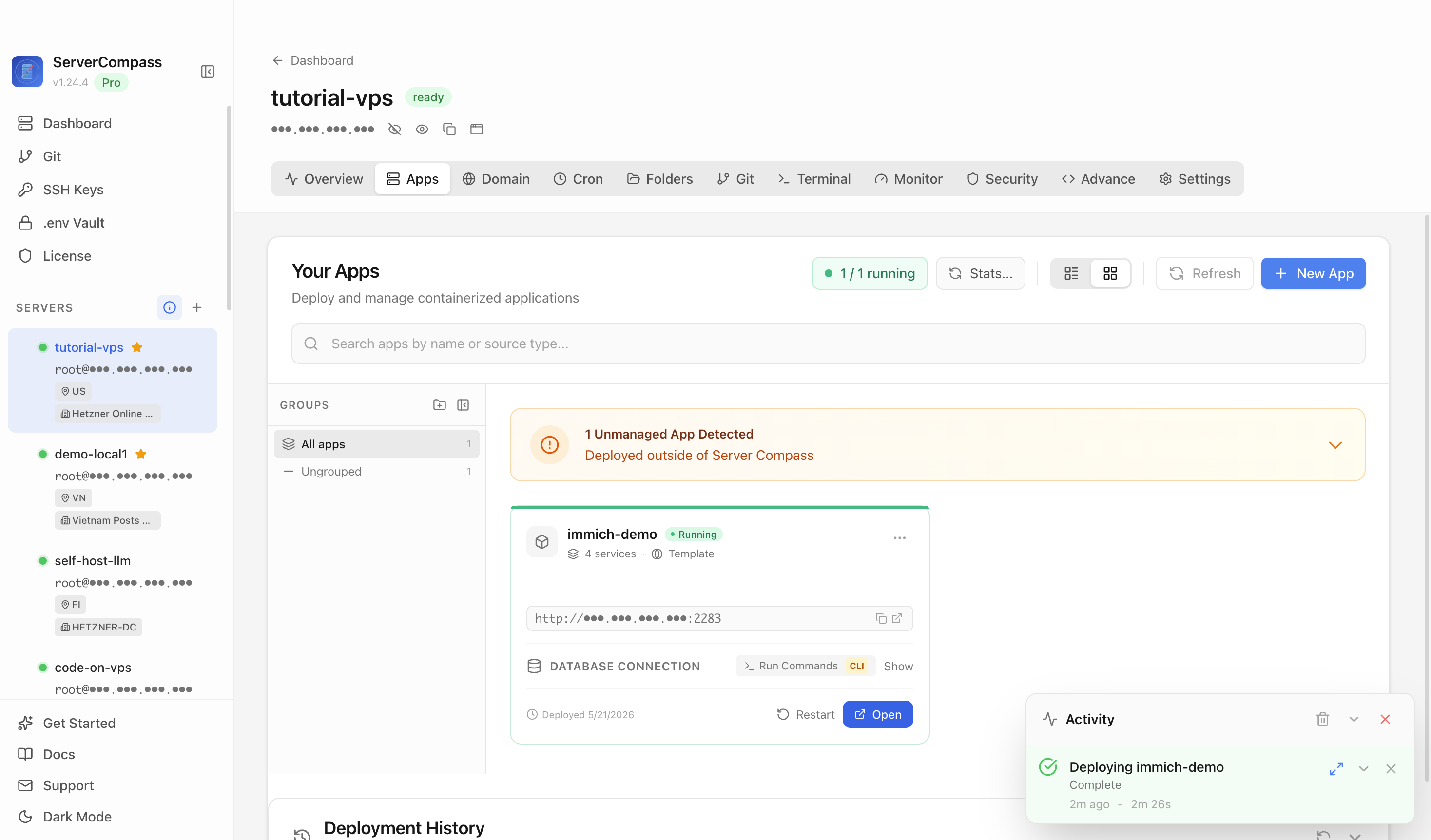 Deploying and managing the app layer in ServerCompass once the Proxmox storage and isolation underneath are settled — apps land on a foundation that won't shift.
Layer 5: backups and monitoring around everything
Wrap the box with selective offsite backups (tier what's irreplaceable) and a single health view. Don't bolt these on after a scare — they're part of the plan, not a reaction to losing data.
Planning checklist
- Storage ownership and fast/bulk split decided before any VM.
- VM vs LXC chosen per workload, not at random.
- CPU/RAM budgeted so spikes stay contained.
- Apps deployed onto the settled base (templates for consistency).
- Backups (tiered/offsite) and monitoring designed in, not after.
Takeaway
An all-in-one first Proxmox server is a great goal reached in the wrong order by most beginners. Build bottom-up — storage, isolation, resources, apps, then backups and monitoring — and each layer holds the next. Ambition isn't the problem; sequence is.
From across the StoicSoft network
Hand-curated reads on the same topic from sister sites in the StoicSoft family.
 Deploy Handbook8 min read
Proxmox panels vs lightweight deploy tools — which one do you actually need?
Homelab and VPS users keep conflating infrastructure management with application deployment. Here's how to tell whether you need a full Proxmox-style panel or just a deploy layer with monitoring.
Read on deployhandbook.com Deploy Handbook8 min read
Best single-dashboard app health for self-hosters who aren't ready for Prometheus
Homelab and VPS users want one calm dashboard for app health — not a full observability stack. Here are the tools that hit the middle layer between SSH and Grafana.
Read on deployhandbook.com Deploy Handbook7 min read
Lighter Than Kubernetes: Compose vs Podman vs K8s for a Single-Node Homelab
You want more structure than loose docker run commands but suspect Kubernetes is overkill for one Proxmox box. A practical comparison of Compose, rootless Podman, Podman Kube, and lightweight K8s.
Read on deployhandbook.com